Travel Photography on Film: Choose a 35mm or Instant Camera Before You Buy
Choose between 35mm film and analog instant cameras, understand compatible film and lab costs, and plan how to carry your photographs home.
Film & instant photography
Articles and audio are currently available in English only.
Listen to this article
Press Listen to play the article.
Download MP3 · 7.2 MBA small instant photograph passed across a table and a roll of negatives collected after a trip offer different kinds of anticipation. Both begin with light exposing photographic film. You choose when to make the picture, and each exposure uses something physical. Before buying a camera, decide which of those experiences you want—and what you are willing to carry, spend and arrange afterwards.
Start with what you want to bring home
Choose an instant camera if making and sharing a physical photograph during the day is part of the appeal. The print is the immediate object: something to keep in a notebook or give to a companion. Film packs limit how many pictures you can make before reloading, so include spare packs in your plan.
Choose a 35mm film camera if you are comfortable waiting to see the results. Exposed film needs processing. You may receive negatives, physical prints, digital scans or a combination, depending on the lab service you select. That choice creates a task after the trip, or a reason to find a suitable lab while away.
A camera you already own may be the best starting point. If it has been sitting in a drawer, test it before relying on it for an important journey. A used-camera seller's test and return policy matters more than how convincingly vintage the camera looks in a photograph.
Analog capture can still use batteries
For this article, non-digital photography means recording the image on photographic film. Batteries, a flash, automatic exposure or an electronic shutter do not by themselves make capture digital.
A digital camera without a screen still records a digital image. A smartphone printer starts with a digital photograph. A hybrid instant camera combines digital capture with a physical print. Those may suit another kind of trip, but they serve a different purpose from exposing film directly.
Fujifilm's instax mini Evo illustrates the distinction: its specifications describe a digital image sensor, image storage and an LCD, alongside printing on instax mini film. The instax Link range is described by the manufacturer as smartphone printers. Neither should be confused with an optical instant camera simply because both can produce an instant print.
Film capture followed by scanning at a lab also introduces a digital step. If your aim is an entirely physical workflow, ask the lab about negatives and prints, including how those prints are produced. Some physical prints are made from digital scans. Choose the workflow deliberately rather than assuming that every film service is the same.
Choose the camera and its film together
Fujifilm's instax mini 12 is one example of a straightforward analog instant camera. Its specifications list an optical finder, automatic exposure, an electronic shutter and two AA alkaline batteries. It uses instax mini film. It is an example for understanding the system, not a claim that it is the newest or best camera available. Check the current model, manual and regional offer when shopping.
Film formats are a buying decision of their own. Instax mini, SQUARE and WIDE belong to different systems. Check the exact compatibility stated on the camera and film package. A multipack's total number of sheets is not necessarily the number in one cartridge.
Polaroid has its own distinctions. Go film is for Go cameras. The Polaroid Now supports i-Type and 600 film, according to Polaroid's documentation. Go film is not a substitute for either. Older Polaroid models require an exact model check: do not assume that a cartridge suitable for one modern camera will power or fit a vintage one.
For roll film, a simple reusable 35mm camera provides another route. Kodak's Ektar H35 is a half-frame example, making twice as many frames on the same roll by using a smaller frame. That changes the format and the number of exposures; it does not automatically halve developing, scanning or printing costs. Ask the lab how it handles half-frame film before treating that format as a saving.
Budget the pictures after the camera
For instant photography, compare the film-pack price with the number of included exposures. Then include the camera, required batteries or charging arrangements, shipping and tax. An unwanted or unsuccessful photograph still consumes an exposure.
For 35mm, add the film, development and any scans or prints you want. Include postage and return of the negatives if you plan to use a mail-in lab. A headline processing price may leave out services you assumed were included.
Choose a lab before the trip ends. Ask whether it handles your film process and format, what the quoted service contains, how long it takes, how you receive scans or prints, and whether you get the negatives back. A lab locator is a starting point for that conversation, not a promise of nearby same-day service in every city.
You do not need to calculate a perfect cost per usable photograph. You cannot know in advance how every frame will turn out. The useful comparison is whether you want the recurring cost and routine of this particular camera-and-film system.
Learn the few controls that matter
Read the actual camera manual and practise loading it before departure. Check its focusing or close-up arrangement, the recommended shooting distance and how its flash behaves. Simple cameras can still have important limits. For example, the mini 12's specifications describe constant-firing flash with automatic light adjustment; do not buy it expecting an unrestricted flash-off control.
Start with a short outing or a test roll. Use it to find out whether the camera works as expected and whether its size and handling suit you. A working shutter alone is not a complete assessment of an old camera.
Look before you raise the camera. Follow venue photography rules, respect other people's privacy and leave room for a moment that does not need a photograph. Film does not make a picture more authentic by itself, and it does not guarantee a stronger memory. Its practical difference is that you are working with a finite physical medium.
Plan for airports before packing film
Carry-on luggage alone does not protect film from modern screening equipment. Kodak Professional advises against CT scanning any unexposed or exposed-but-unprocessed film, and advises against putting film in checked bags.
Its guidance recommends carrying film in a clear resealable bag and requesting a hand inspection, while explicitly warning that a hand inspection may not be available. Check the airport's current procedure before travelling and follow its instructions. A manufacturer's warning sheet can explain the concern; it does not give permission to bypass screening.
If suitable inspection will not be available, consider whether buying and processing film locally would work for the journey. Check the actual shop and lab arrangements first. Do not assume every destination has the film you need.
A finished instant photograph is different from exposed but unprocessed 35mm film. Avoid treating the word “exposed” as if it meant the same finished state in both systems. Check the film manufacturer's guidance for the material you are carrying.
Keep film and photographs in suitable conditions
Follow the storage instructions for the specific film rather than applying one rule to every product. Fujifilm advises cool, dry storage away from heat, direct sunlight and extreme temperature changes, with spare film sealed. Polaroid gives its own guidance for unused packs, including refrigeration without freezing and allowing film to return to ambient temperature before use.
Do not leave spare film in a hot car or in direct sun. Give physical photographs a protected place in your bag and follow the manufacturer's developing and handling instructions. Pack the batteries or charging equipment the camera actually requires; analog capture does not mean every camera is battery-free.
After the trip, keep negatives and prints identified by date and place. If you order scans, decide where to store them and how to keep the originals. The choice can remain simple: a few physical prints, a roll of negatives or both, kept in a form you will want to revisit.
Where to buy your camera and film
Begin with the manufacturer's regional shop or dealer information for the exact model. A specialist camera shop or a film lab can also help explain compatible film, loading and local processing. For a used camera, look for a clearly stated test and return policy and allow time to test it before departure.
When comparing an Amazon listing, check the seller as well as the product name. Confirm the model and generation, whether capture is analog or hybrid, which film it takes and what the bundle actually includes. Check film type, sheet or roll count, expiry information, batteries or charger, regional warranty, returns and delivery destination.
A bundle with many accessories is not automatically more useful than the camera and the right film bought separately. Start with what you will use. Avoid judging an offer from the camera photograph alone: similar-looking products can belong to different film systems or use digital capture.
Sources and review date
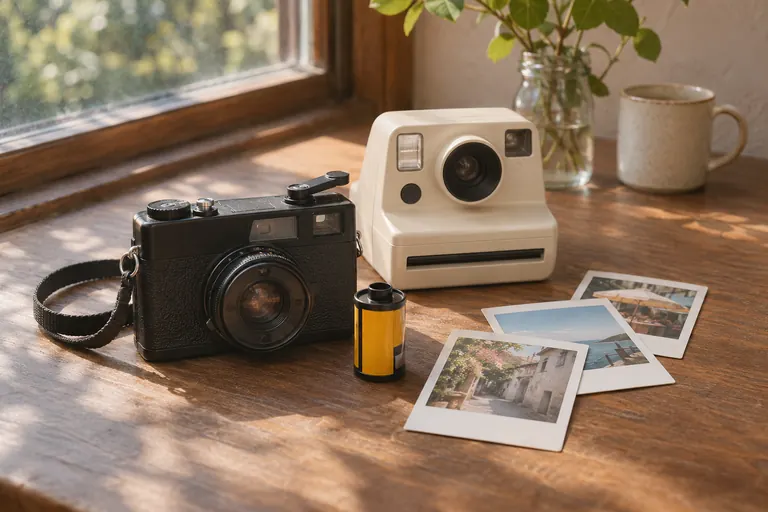
Checked November 6, 2026 against manufacturer specifications, film-care and screening guidance, and first-party laboratory information. This is a documentation-based comparison, not a hands-on camera review or an airport-inspection guarantee. Models, regional offers and airport procedures can change. No affiliate links or particular retailer offers are included. The cover is an AI-generated editorial image of generic cameras, not a photograph of the reviewed models.
- Fujifilm: instax mini 12 specificationswww.fujifilm.comhttps://www.fujifilm.com/us/en/consumer/instax/cameras/mini12/specifications
- Fujifilm: instax mini Evo specificationswww.fujifilm.comhttps://www.fujifilm.com/us/en/consumer/instax/cameras/minievo/specifications
- Fujifilm: instax Link smartphone printerswww.instax.comhttps://www.instax.com/smartphoneprinter/en/
- Fujifilm: mini film formats and pack contentswww.instax.com.auhttps://www.instax.com.au/mini-film/
- Polaroid: Go film compatibilitywww.polaroid.comhttps://www.polaroid.com/en_us/products/color-go-instant-film
- Polaroid: film for Now camerassupport.polaroid.comhttps://support.polaroid.com/hc/en-us/articles/360012374860-What-film-does-Polaroid-Now-camera-use
- Polaroid: film-format and cartridge-battery guidesupport.polaroid.comhttps://support.polaroid.com/hc/en-us/articles/115012394347-What-film-do-I-use-with-Polaroid-cameras
- Kodak: Ektar H35 half-frame camerawww.kodak.comhttps://www.kodak.com/en/consumer/product/cameras/film/h35-film-camera/
- The Darkroom: 35mm processing servicethedarkroom.comhttps://thedarkroom.com/product/35mm-film-developing/
- Fujifilm North America: lab locatorwww.ishootfujifilm.comhttps://www.ishootfujifilm.com/lab-locator
- Kodak Professional: CT scanning and filmkodakprofessional.comhttps://kodakprofessional.com/en-gb/photographers/resources/ct-scanning-x-ray-technology-and-film
- Fujifilm instax: airport screeningwww.instaxus.comhttps://www.instaxus.com/faqs/can-i-take-my-film-through-airport-x-ray-machines/
- Polaroid: travelling with filmsupport.polaroid.comhttps://support.polaroid.com/hc/en-us/articles/115012362927-How-to-travel-with-Polaroid-film-X-Rays-at-Airport
- Fujifilm: film storageinstax.co.ukhttps://instax.co.uk/how-to-keep-your-instax-film-fresh-and-flawless-2/
- Polaroid: film storagesupport.polaroid.comhttps://support.polaroid.com/hc/en-us/articles/115012362747-How-should-I-store-Polaroid-film